Showing posts with label Goan. Show all posts

Sunday, 24 May 2015

Akki Bhakari/ Akki Rotti/ Tandula-chi-Bhakari

Indian Flat-bread Akki Bhakari/ Akki Rotti/ Tandula-chi-Bhakari
Akki Bhakari/ Akki Rotti/ Tandula-chi-Bhakari

Flatbreads are a part of Indian menus. We, Indians make flatbreads out of wheat, jowar/sorghum, and millets like ragi, bajra and many more grains  I do not know about.

Indian flatbreads like its culture and cuisine is diverse but still there is a thread connecting them all. You can read about Indian flatbreads here.

Coming to today’s CCC challenge I am making Akki rotti (like the Lingayats community will say in my hometown) or Akki Bhakari like the Brahmin community will say!

Akki bhakari was a standard food growing up.  It used to be like jowar one only whiter, easier to eat and hot straight from the tava/skillet to the plate!

This used to be breakfast and then straight to books after that to do holiday homework!

Amma never added spring onion or dhania/ coriander or chillies but here in Goa the same is made with all the above and is called Tandula chi bhakari.

Remember the thread that connects the whole of India! You will find the same foods with a slight variation all over India.

It’s delicious and hubby loved it.

Akki Bhakari/ Akki Rotti/ Tandula-chi-Bhakari

Akki Bhakari/ Akki Rotti/ Tandula-chi-Bhakari

Ingredients:
  • 1 cup Rice flour
  • 1 bundle of spring onions, chopped fine
  • 2-3 green chillies, chopped fine
  • 3 tblspn coconut, freshly grated
  • A few springs of dhania/ coriander
  • Salt to taste
  • Oil to fry
  • Water
Foil
Non-stick tava/skillet
Method:
  • In a bowl add the rice flour, spring onion, green chillies, coconut coriander and salt.mix well.
  • Pile the mixture in the middle and make a well in the centre.
  •  Using hot water and a spoon mix a little water. Add water gradually the idea is to get a soft dough without it being sticky.
  • Once the dough is ready make small balls the size being smaller than that of tennis balls but bigger than a lime. Set aside.
  • Heat the non- stick tava/skillet.
  • Oil the foil and place one ball on the smeared portion.  Flatten the ball on the oil gently turn it over and using your fingers flatten the dough to make a thin circle about 1/8 inch in thickness.
  • Place the foil on the tava/skillet with the flattened circle on the tava/skillet. Let it cook for 2-3 minutes then you will be able to peel the foil off and reuse to make the next roti.
  • Meanwhile the roti on the tava/skillet needs your attention. Use a tsp to oil the sides of the roti. Flip it over and cook on the other side. The roti is done when it gets slight brown flecks and changes colour.
  • Serve hot with homemade butter.
Akki Bhakari/ Akki Rotti/ Tandula-chi-Bhakari

This joins the May Week 3 Cooking from Cookbook Challenge Group.


Hi! First time here? Well then you are Most Welcome! I hope you keep coming back for more here. If you are my regular visitor then Thanks, for you encourage me to experiment more!! I would like you to please click on my link below and like my Facebook Page. I will be happy if you can follow me on on Twitter too!

 Photobucket

Friday, 8 May 2015

Alsande cho Tonak at BM#50 Meet

Alsande cho Tonak

"Make Alsande Tonak "

And I panicked and made a SOS visit to Sheetal!

What am I talking about? 

My readers, I am a part of Bloggers Marathon, a group of us who blog every month on various themes.
Naturally we are all very close, it’s more like a family group and we meet. We met in Chennai this year and it was fun.
On the last day we were go to Foodology, an amazing place for foodies.
Valli and Padma asked me to make Alsande cho Tonak and I decided to ask Sheetal, my guide for all these traditional recipes!
I must thank Valli and Padma for the honour not mention Kamalika for organising the place!
This is a mild tonak you may use more of the masala starting from laung/cloves to chillies to get stronger gravy.


Alsande cho Tonak

Recipe Source: Sheetal
Ingredients:

  • ½ kg alsande, soaked overnight
  • 1 onion, chopped fine
  • 1 tomato chopped fine
  • 1 coconut, freshly grated
  • 1 onion, sliced
  • 3-4 garlic cloves
  • 10 laung/cloves
  • 1 inch dalchini/cinnamon ( adjust)
  • 3 tblspn dhania/ coriander seeds
  • 4-6 kali mirch/ pepper corns
  • 12-13 dry chillies
  • ½ tsp saunf/fennel seeds
  • Haldi/turmeric
  • 1 pinch nutmeg
  • 2 dagad phool/star anise petals
  • Oil
  • Salt
Method:

  • In the alsande add the onion and tomato and salt you can either pressure cook for 2-3 whistles or cook outside in an open pot till the alsande are cooked.
  •  Meanwhile in a kadhai/wok add a little oil and fry the cloves, cinnamon, coriander seeds, pepper, dry chillies, fennel seeds, nutmeg and the star anise and   set aside.
  • In the same kadhai/wok roast the coconut with the onions and garlic.
  • Grind the coconut with turmeric to a fine paste.
  • Add to the alsande and bring to a boil. Add salt to taste.
  • Serve with pav garnished with dhania/ coriander.
This joins the May Week 1 Cooking from Cookbook Challenge Group.


Linking to  The Veggie Indian, Lisa’s blog and Susan’s blog.

Hi! First time here? Well then you are Most Welcome! I hope you keep coming back for more here. If you are my regular visitor then Thanks, for you encourage me to experiment more!! I would like you to please click on my link below and like my Facebook Page. I will be happy if you can follow me on on Twitter too!

 Photobucket

Saturday, 7 June 2014

Neerphanas aa chi Bhaji/ Green or Raw Breadfruit Vegetable

We were on out whatsup talking about Breadfruit. Some of my friends wanted to know the difference between a breadfruit and jackfruit.
Breadfruit looks like this.
Bread Fruit Courtesy:Google

 Somewhat different form a jackfruit isn’t it? A jackfruit looks like this.
Jack Fruit Courtesy :http://raingold.com.my/site/jackfruit


 But unlike a jackfruit a breadfruit is used raw at least in Goa its use raw or green as the Americans say. I understand that bread fruit is  used ripe too in the Caribbean. Bread fruits are common in Kerala, South Tamilnadu, Maharashtra, and Goa. Apparently is used to make sambar etc in the south.

Now in Goa you will find these breadfruit trees aplenty, they will ripen and fall down but once they come to the market they are so very expensive. This season they touched Rs.250/- a piece! The rate varies according to the size and the freshness of the neerphanas as it is known locally.

In Goa the breadfruit or neerphanas is used to make Kappa’s, a shallow fried slice that is relished, in tonak or to make a dry vegetable called Neerphans bhaji!

This bhaji is not much appreciated by my kids so I make it when I have no other vegetable or when I have too much of neerphanas! Too much happens when we are gifted the neerphanas or when hubby cannot resist them and comes home with 2 or 3 of them!

Anyway as  I  said  we were discussing the making of this vegetable with PJ then I decided to make it anyway since I needed to feed my blog baby! :D

Monday, 12 May 2014

Ambe che Sasav/ Mango Sasav ~A traditional Goan Dish

Ambe che Sasav/ Mango Sasav

The market is flooded with mangoes this season. The aroma of the mangoes is so delicious that I wonder why I plan on making a vegetable, dal, chapattis, rice etc. Can we just not eat mangoes?

Though my younger daughter will worship me for suggesting this, my older one will happily ask me for money to eat in the canteen! She hates mangoes and cannot stand the smell of them!! Well it takes all kinds…

There are many varieties of mangoes available here in Goa to name a few we have  the famous Mankurad , Malgesh, Culas, Bishop or  Bispo, Afons or Goa Appus or Goa Alfonso, Hilario  also known as Mang Hilario, Mangilar, Mangilal, Mussarat or  Mussarat or Monserrate de Bardez, Fernandin, Xavier. Each has a different use like mussarat is used to make jams.

This is what I have already made with ripe mangoes Ambe che Satt or Mango Jam,Mango Shake, There is Aam Ras, Amrkhand a few more options that will be shortly coming up. With raw mangoes I have blogged Raw Mango in Salt,Raw Mango Chutney, Panha, Mavani kai Chitraanna or Raw Mango Rice. O I have never blogged mango pickle Mixed Pickle yes but no Mango pickle. Okay that the next one. I make them often!

Monday, 7 April 2014

Rasatle Fov or Pohe In Coconut Milk (Savoury)~ Indian State Goa

Rascche Fov/Rasatle Fov~Goan Cuisine
I have the unique status as a Kanadiga married to a Maharstrian but the person considers himself to be a Goan!

 So in the blogging Marathon today we are at Goa.

 Some of you may have ideas about Goa ! Goa is beach, sun, Carnival and drinks but as a resident I see Goa quite differently I am trying to share that here. Maybe this article is to make myself understand the similarities in all our customs where the moral of the story is victory of good over bad!
A Mermaid a Landmark  in Panaji, Goa

There is plenty said on Goa, its cuisine but do you know how Diwali is celebrated in Goa? The similarities and differences with the customs in Maharashtra and in Karnataka. 

Diwali is celebrated on 5 different days some have the celebration from the Dhanteras but in Maharashtra it starts with Vasubars, a day before, on this day the cow and calf are worshiped.

The next day, is Dhanteras where we purchase gold etc. in Karnataka it is also called as “Neer Tumbo Habba” the festival of filling water.  It used to be quite a sight all the big utensils in which water was stored used to be washed and before refilling slaked lime and vermilion used to decorate them.  They looked so beautiful!!

I still remember when I was small my Mama, Madhu mama was posted in a small town called Harihar. Water was heated for bathing in a huge wood fired pot. This pot was enclosed in a structure that was built with bricks and cement. Only the opening of the pot was visible and water was poured in/out through this opening.  Wow the water used to be super hot….. Anyway I remember Mami emptying the pot to wash it. How she washed it I d not know must have scrubbed it with the coconut scrubber and ash.  The typical cleaners then, economical and ecofriendly!!

There is the sky lamp or the akash kandil is hung and the rows of lights are lit in the evening.

 Day 2 is Narakchaturdashi!! This is the night when the demon Narkasur was slayed by Krishna and he returned in the wee hours of dawn.  To help him to find his way Rukmini his divine consort lit lamps. On Krishna‘s safe return she was so happy that she performed “aarti”!

The tradition is followed even today in Karnataka. As kids we used to wake up early at around 5 am, lit a few lights and “aarti” was performed. This was followed by abhangya sanan or bath, new clothes donned and eating of the sweets that Amma had made. In between we managed to distribute the trays of sweets to neighbours.

In Goa however there are effigies made and then they are burnt in the wee hours of the mornings. Then in the morning there is an abhangay sanan, aarti and eats made form fov or beaten rice.  (More about fov later let’s finish Diwali and its many festivities first)  Evening is meant for Laxmipuja in case there is murath and visiting friends and relatives. Feasting and enjoying.

Day 3 its Padwa it commemorates the defeat of the King Bali at the hands of Lord Vishnu in the form of Vaman.  This is the day when Bali returns to earth for one day.

Then its day 4 where the brothers and sisters come together to celebrate. Bhau beej or Bhiaya Dooj.  On this day the brother visits the sister and the sister puts tilak on him, performs aarti, feed his different delicacies. The brother on his part promises to take care of her safety and well-being.

Actually in Karnataka we have another day which is called "Akkain Tadgi" the sister gifts the brothers. ( Even then it was not a oneway traffic)! But now this is rarely celebrated.

This may the end of Diwali for this is the last day of festivities.  The   Aakash Kandil and the lamps are put away. The   leftover sweets and savouries are finished. Then the wait starts for the next Diwali!

Not so in Goa we continue till " Tulsi Vivvah" its called "Vali Diwali" Vali meaning Big!

So what do you do on Diwali day? What are the rituals that are  followed in your part of the world? Do you have some traditions that are a must do?

 But wait I have said that in Goa we have fov. Fov is Pohe or beaten rice. We have different kinds of fov made.  This is our spread!
Diwali che Fov /Diwali Spread

Sunday, 6 January 2013

Tousule for Magic Mingle #13


Tousule is a Goan delicacy made in the rainy season.

Why rains?  Well cucumbers the main ingredient of Tousule is grown in plenty in the hilly areas and is sold not only on the roads but also in the markets. Its common sight for the farmers themselves selling the freshly plucked cucumbers. Also one more ingredient the turmeric leaf that is used to give a delicious aroma to the Tousule.

Traditionally the Tousule is made out of rice suji or rava or wheat rava fine or thick kind, cashew nuts, coconut and jaggary are used to create this beautiful steamed delicacy called Tousule.

When Kalyani announced the Magic Mingle of cucumber and walnuts I was sure I will never make it. Then I saw Gayatri post of zucchini bread and something went click in my head and I thought Tousule.

Well if you are a regular visitor here you will know sweets, let me clarify some sweets, are unmentionables in my place this happens to be one of them. I made minimum quantity of 1 katori. But please let me not put you guys off the Tousule it is amazing. Do try it out.

Saturday, 8 December 2012

Caldin ~A Goan Catholic Veggie


You have heard me rant quite a bit that the Goans do eat veggies contrary to the popular view. Of course the veggies are few but they are tasty. My view of all the veggies was that they are all covered with masala in the Goan way.  How wrong can a person be!! Even after staying in Goa for 25 years I am still uncovering dishes, vegetarian mind you.

I was chatting with my friend Judy and happened to ask her what Caldin is. Caldin is traditionally a Goans Catholic veg dish. It means ‘in a gravy.’  

  Surprised? Even I was quite amazed.

I did ask her quite rudely, I might add, Catholics and veggies. Her reply was quite a revelation. We cannot eat meat all the time dear, she said we feel the need to eat veggies too. Of course the veggies used in Caldin are like cauliflower, lady finger, potatoes quite a few but we do eat them.

She did share the recipe with me. Not content that night we went out for dinner and Apeksha n I ordered Caldin and enjoyed it.

Now since I did not have all the veggies at hand thanks to the fact that I had not done my weekly shopping I had to make do. So my Caldin had only cauliflower and some tired looking carrots! And still the caldin was appreciated.

Ingredients:

To grind:

  • A small knob of Ginger
  •  4 cloves garlic
  •  ½ tsp Coriander seeds
  •  2 Green chillies
  •  ¼ tsp Haldi
  •  ¼ tsp jeera
  •  ¼ cup coconut

For the coconut milk:

  •  1 coconut grated

Rest of the ingredients:

  •  4 cups mixed vegetables
  •  3 medium onions, finely chopped
  •  2 tomatoes, finely chopped
  •  A lemon sized ball of tamarind
  •  Oil
  •  Salt

Method:

  1. First extract coconut milk on e thin and one thick. In case you need here is how.
  2.  In thin milk soak the tamarind.
  3.  Grind all the ingredients under to grind heading to a fine paste using a little water.
  4.   Fry onion till translucent add the tomatoes and fry till they are softer.
  5. Add the ground masala fry on a low flame.
  6.  Add the thin coconut milk. Add veggies, salt & boil covered till the veggies are par-boiled.
  7. Add the thick juice. Cook till done.
  8. Serve with steamed rice or rotis. The Goans will prefer it with pav or uno.
Linking this to Julies's Event Garlic and Spice Guest Hosted by Vidya

All rights reserved on photographs and written content are copy-written @The Mad Scientist’s Kitchen!! unless mentioned. Please Ask First
  Photobucket

Monday, 8 October 2012

Udmethi

Amade che Udmethi
When I read the Magic Mingle ingredients this month there was a smile on my face. Finally I was to post one of Goa’s most delicious curries. The one that I have made many times and started to write so many times and deleted so many times.

The beauty of this curry is that it can be made vegetarian and non vegetarian both.

The magic is made with urid dal and fenugreek and “Ammado”!

These sour beauties called Ammado  are available almost all the year around. In rains they are tender and taste like raw mango. The pickle made from this is Sluuuurp! As the rains get over at about Ganesh Chathurthi time they have a slight flesh ad there is a hard fibrous nut kind of centre. These delicious fruits are a must for Ganesh and Diwali celebrations, when they are made in delicious chutney.
Ammado

I will post the more about the chutney later, right now it’s Magic Mingle and its magic ingredients of coconut and fenugreek.

Like I said Ammado are used to make vegetarian and non-vegetarian curry. The non vegetarian curry is made with prawns!!

Most Goan curries use coconut as a base with coriander seeds and red chilies. There are some curries where there are additions of pepper, cinnamon etc but the most important curry ingredient is coconut.  Goans use very little curry in their rice. The rice is almost dry the reason I think being that coconut is high in cholesterol and the protein content is taken care of by the fish. So it not eaten like daal.
  
To make the vegetarian curry called
  Udmethi

 Ingredients: 


             ·      10 Ammado
·      ½ Coconut, freshly scrapped
·      1 tblspn urid dal
·      ½ tsp fenugreek
·      4 Red chilies (I used the Goan chilies)
·      ½ tsp turmeric
·      1 small piece of hing/ asafetida or about ½ tsp powder
·      2-3 tsp oil
           ·      Salt  

Method:


1.    Wash and peel the Ammado using the vegetable peeler.
2.    Now with a heavy stone/hammer pound the Ammado till they are a bit broken. (This step I do not follow many times but it’s desirable. All the curry juices seep in and a slight sour taste seeps easily in the curry). Set aside.
The ingredients sans the turmeric

3.  In a kadhai/wok heat the oil fry the hing piece drain well and set aside. Next add the red chilies and fry till they give out an aroma. Drain and set aside.
4.    In the same oil fry the urid dal till reddish add the fenugreek and switch off the gas. Drain the dal and methi.
5.    Grind the coconut, methi, urid dal, red chilies, turmeric and hing to a fine paste using little water. This is your masala.
6.     Heat another tsp of oil and toss the Ammado in. Stir for about 2-3 minutes then add the ground masala.
7.    Add salt and some water. Say about 3 cups. Bring to a boil.
8.    Adjust the seasonings, the thickness of the curry to your liking by adding water. Mine here is quite thick.


Serve udmethi with  steamed rice, pickle,rava fried cauliflower!!


All rights reserved on photographs and written content are copy-written @The Mad Scientist’s Kitchen!! unless mentioned. Please Ask First
  Photobucket

Wednesday, 26 September 2012

Toi~ Dal The Goan Way


Like I have said somewhere here in this blog not many people are aware that Goan have a number of delicious vegetarian dishes!

 Today on the last day of BM I will like to share one delicious Goan Dal.

 The vegetarian dishes are made " satvik" no onion, no garlic. Difficult to believe but Goans are a deeply religious lot and there days in a week when the average Goan goes "Shivrak" that is vegetarian... . Reluctantly, of course but they do adhere to the age old custom!

So on days the Goan is "shivrak" he/she has "chanyacho ras", some vegetable, rice, batat kapa (which are shallow fried potatoes) and rice, toi .

Chanyaco ras is made using peas, vegetable is many times radish or ridge gourd but toi is dal.

Fragrant and delicious!!

Thursday, 19 July 2012

Mooga Gathi


What have I been thinking or rather not thinking. 
Moong and pepper & moong and pepper and one of Goa most delicious sprouts veggie.

 I just do not think these days. What nut I can be!

Anyway I did think of it that is important.

I have already said that Goan’s are a religious lot. In the Hindus there are days when they will not eat fish, onion and garlic. Surprised? Well so was I. They do crib about it but then they follow the rules.

What they have during these days is an explosion of tastes and masalas. One such dish is Mooga Gathi!!

Tuesday, 3 April 2012

Usali the Goan Way


I have been living in Goa for many years but still one article that was printed in the Times of India was an eye-opener.

The author of the article was Melinda Pereira Kamat and she wrote about The Perfect Usali, in case you are interested it is featured in the Times of India, Goa edition on Tuesday, July 13, 2010.  I was supposed to scan and post it here but... hope will do so in near future. 

Till I read this article my view about usal or usali was that it is made in Karnataka and Maharashtra/Gujarat and the method that I followed was about similar to what my mother and MIL made. That is it has garlic and onion for Kaku (my MIL) made it that way and it had coriander and coconut ground for Amma. So I had mixed both and made my usal.

Thursday, 22 December 2011

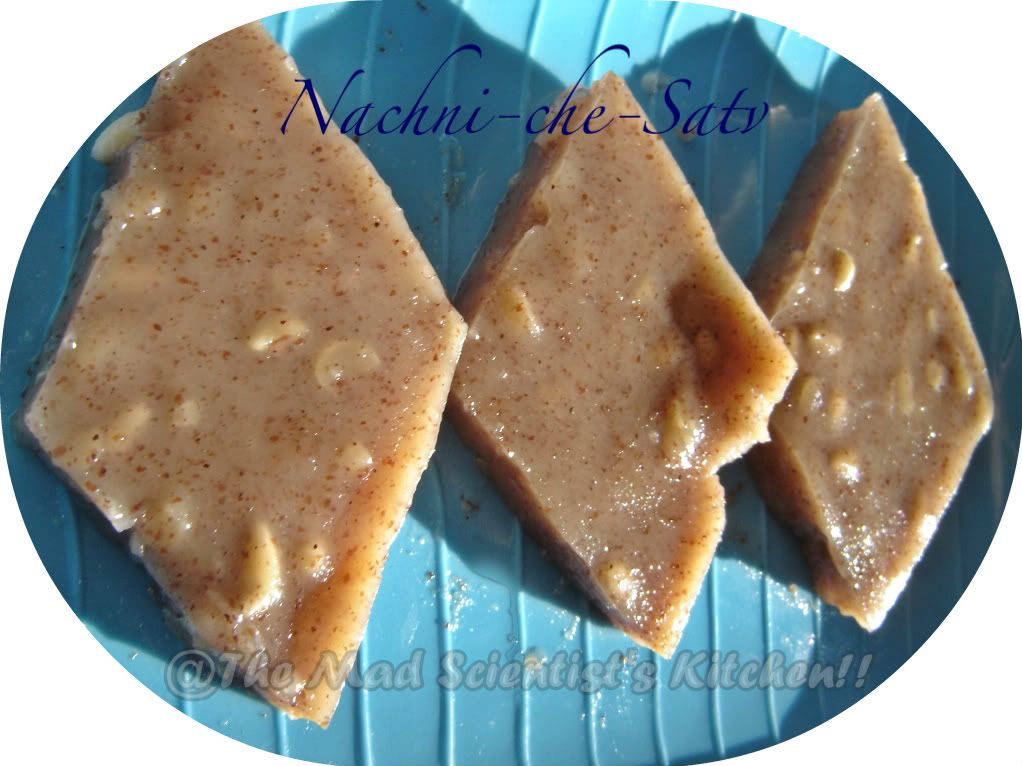
Nachni-che-Satv or Ragi Pudding


Staying in Goa from the time I got married 23 years to be exact has exposed me to quite a few wonderful dishes in this cuisine.

There is a preconceived notion that there are no vegetarian dishes in this cuisine. I remember when I was to be married all my neighbours and friends kept on telling me that I will have nothing but “Samudra chawlikai” that is cluster beans from the sea. Of course fish is the staple food here in Goa, but a Goan does “go veg” at least 2 times in a week and on all kinds of festivals, panchmi, chathurtis etc.

Any celebration and you have “mangane” a kind of kheer and of course “Nachni-che-satv”.

Nachini or ragi is a very nutritious. It is good for infants and old and the in-betweens also. Its calcium and iron is easily assimilated by the body. Try this wonderful grain in sweets and savoury food stuff alike.Read more about it here.

Sunday, 30 October 2011

Coconut Semolina Cake~ Goan Bath

 To all Goans I am someone who is weird.
 At least most of my friends consider me strange as I don't use Naal or coconut, as it is known in Konkani, as much as they do. For most (read all) of their curries coconut is a must, be it fish curry or tonak.  They talk is 1 coconut or two and not having coconut at home is something equivalent to not having salt at home.

 Most Goan dishes sweets like Bebinca, Dodol are well known and are made of Coconut milk. Bath or Batkh as it sometimes pronounced is a delicious dish not too well known is made out of coconut and rava.


Monday, 15 August 2011

Drumsticks/ Shevgya che Shenga /Nuggekai/ Shango Curry


Just imagine your friend asks for something and since it is not readily available you decide to give it later and then you forget…!!

Unforgivable!!

This is exactly what I have done but I hope my friend Mythreyi does forgive me!!

She had posted some drumstick recipes and wanted some more of curry recipes with them. Drumsticks/ Shevga che shenga  /Nuggekai/ Shango as they are know in English/ Marathi/ Kannada/ Konkani  are a rich source of calcium and potassium. Read about it here.

I was quite surprised that I had not posted this curry that I make often. In my mom’s place it is used only in sambhar, my mother-in-law used in kadhi, I have not made the kadhi yet but will try it out soon. 

This recipe is what my friends’ mom used to make and since the kids loved it I copied it.  You can as in the original recipe add prawns which taste yummy but I am clueless about cooking them.  You are the expert if you are using prawns but I will guarantee the taste!

The Ingredients are simple:
5 drumsticks, chopped the size about 2 knuckles
½ a coconut, freshly grated
1 tsp rasam powder or sambhar powder (adjust as per taste)
A small ball of tamarind
½ tsp turmeric
½ tsp chilli powder
3 cloves garlic (optional)
1 small ball of jaggery
1 tsp oil
Mustard
Hing/asafoetida
Salt
Coriander

Method:
1.       Place the drumsticks in a wide vessel use just enough water to cover all the drumsticks mix salt. Cover and par boil.
2.       Meanwhile grind the coconut, the masala powder, tamarind, turmeric, chilli powder, garlic (if used) and jaggery to a very fine paste using little water. Many times I grind the masala only after I have boiled the drumsticks and I use the water from the drumsticks only.
3.       Pour over the masala over the drumstick and bring to a boil. Adjust the seasonings.
4.       In a small pan heat the oil, splutter mustard, then hing/asafoetida.
5.       Pour over the drumstick curry. Cook till the drumsticks are done.
6.       Serve with steaming hot rice.


Related Posts Plugin for WordPress, Blogger...

Copyright